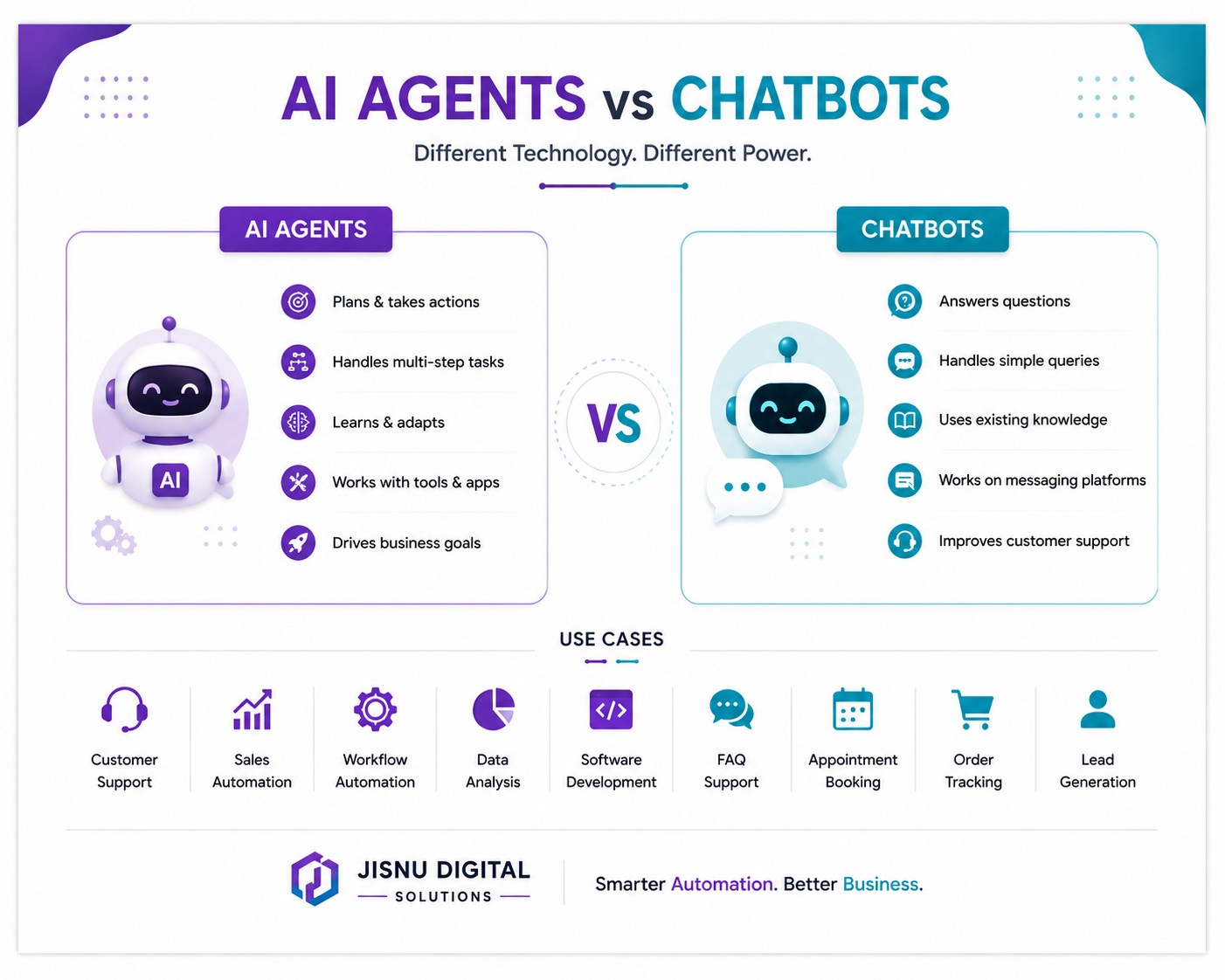
AI Agents vs Chatbots: What's the Difference? (2026 Guide)
🔥 Latest AI Agent Updates – June–July 2026
Introduction
Artificial Intelligence has swiftly changed the way businesses engage with customers and streamline daily operations. For years, chatbots were the go-to AI solution for answering customer questions, offering support, and guiding users through websites and mobile apps.
Now, a new wave of technology known as AI Agents is revolutionizing how businesses leverage artificial intelligence. Unlike their chatbot counterparts that primarily respond to inquiries, AI Agents can reason, plan, make decisions, learn from context, and complete entire tasks on behalf of users.
This guide will walk you through what AI Agents and Chatbots are, how they function, their main differences, and which option might be the best fit for modern businesses in 2026.
What Is a Chatbot?
A Chatbot is a software tool designed to mimic conversations with users. It communicates through text or voice, offering either predefined or AI-generated responses based on what users ask.
You’ll typically find traditional chatbots on company websites, e-commerce platforms, banking apps, customer support portals, healthcare sites, and educational platforms.
Modern AI chatbots, powered by Large Language Models (LLMs), can grasp natural language, understand context, and handle follow-up questions with ease. Learn more about LLM-powered tools.
What Is an AI Agent?
An AI Agent is a more sophisticated AI system that goes beyond just understanding conversations. It can reason, plan, make decisions, and carry out tasks on its own.
Unlike chatbots that wait for users to prompt them, AI Agents can plan multiple steps, analyze complex situations, interact with external software and APIs, perform actions automatically, learn from past interactions, and adapt to new information.
Think of an AI Agent as a digital employee that actively works towards achieving objectives.
How AI Chatbots Work
- The user poses a question.
- The chatbot analyzes what’s being asked.
- It taps into its knowledge base or language model.
- A response is generated.
- The conversation flows until the user's question is fully addressed.
Chatbots shine in customer support, FAQs, booking appointments, product recommendations, lead generation, and order tracking.
How AI Agents Work
- Grasping the user's objective.
- Breaking that objective down into manageable tasks.
- Planning the best way to tackle it.
- Utilizing available tools or software.
- Carrying out multiple actions.
- Monitoring progress and adjusting the plan.
- Delivering the final result.
This makes AI Agents capable of handling complex tasks that once required human effort. Explore advanced AI systems.
Key Differences Between AI Agents and Chatbots
| Aspect | Chatbots | AI Agents |
|---|---|---|
| Purpose | Answer questions and provide conversational support | Complete tasks, automate workflows, and achieve goals |
| Decision-Making | Based on pre-existing knowledge or logic | Reason through challenges and choose best path |
| Task Execution | Provide information | Perform actions (send emails, update CRM, run campaigns, etc.) |
| Memory & Context | Limited memory | Long-term context and learning from history |
| Integration | Messaging platforms | CRM, ERP, APIs, databases, business tools |
Benefits of AI Chatbots
- 24/7 customer support
- Instant responses
- Lower support costs
- Quicker customer service
- Lead qualification
- Enhanced customer engagement
Benefits of AI Agents
- Smart decision-making
- Workflow automation
- Handling multi-step tasks
- Tailored customer experiences
- Increased employee productivity
- Improved operational efficiency
- Ongoing learning and adaptation
AI Agents vs Chatbots: Which One Should Businesses Choose?
The best choice depends on your needs:
Use Chatbots for: Customer support, FAQs, basic lead generation, appointment scheduling, and product information.
Use AI Agents for: Business process automation, intelligent decision-making, complex workflows, sales automation, and multi-system task execution.
Many organizations now combine both — chatbots for conversation and AI Agents for complex tasks.
Real-World Applications
Businesses are using AI Agents for sales prospecting, customer onboarding, HR recruitment, IT support, software testing, marketing automation, financial reporting, data analysis, and project management.
The Future of AI Agents
Experts predict AI Agents will team up with each other, oversee entire workflows, make autonomous decisions, and become standard in business operations. Anthropic, OpenAI, Google, and Microsoft continue to push the frontier.
Common Misconceptions
Many think AI Agents and Chatbots are the same. In reality, chatbots focus on conversation while AI Agents integrate conversation with reasoning, planning, and execution.
Conclusion
Both technologies are reshaping business, but they solve different challenges. Chatbots excel at communication and support, while AI Agents lead the future of intelligent automation. Organizations blending both will gain significant competitive advantage in 2026 and beyond.