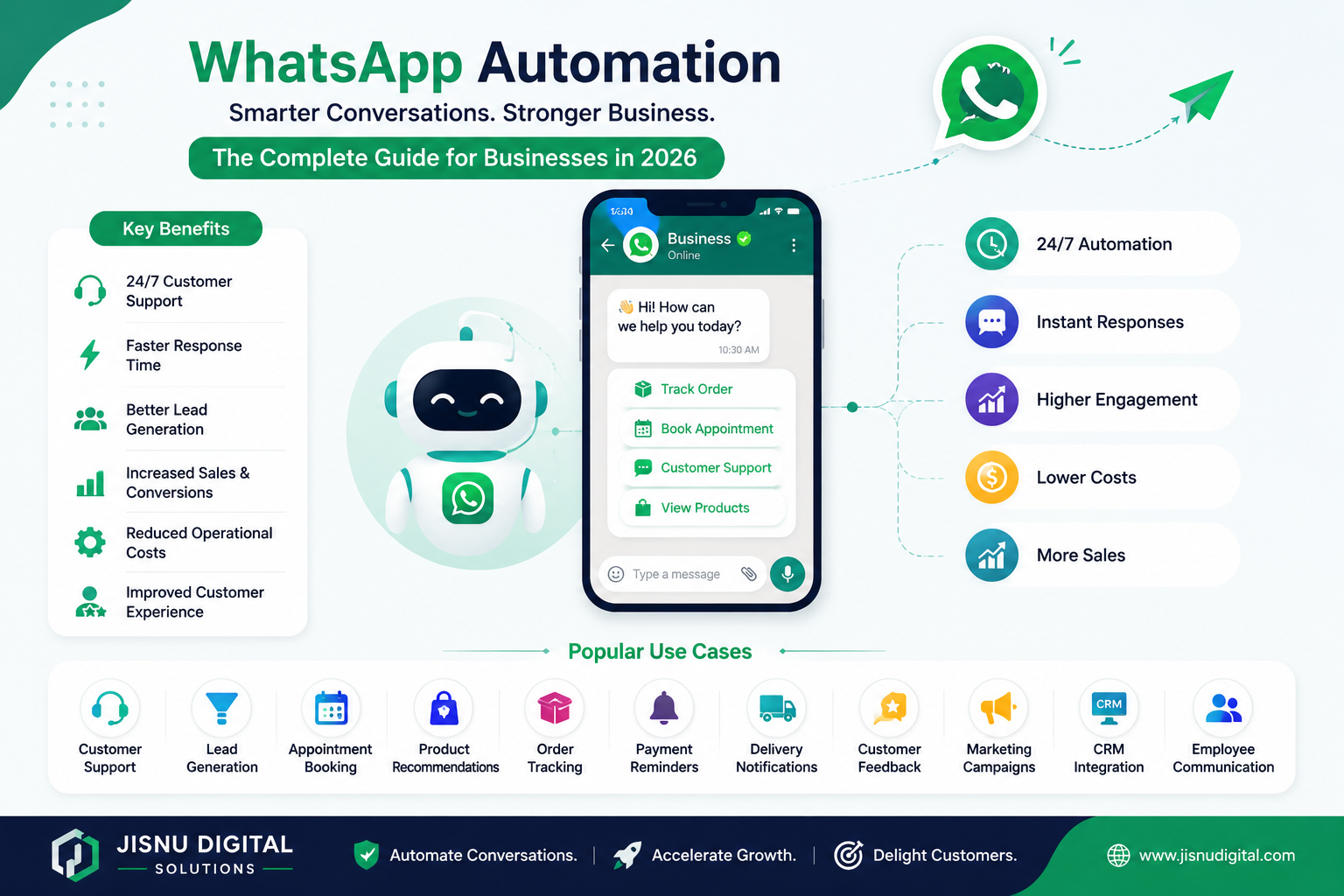
WhatsApp Automation: The Complete Guide for Businesses in 2026
🔥 Latest WhatsApp Business Updates – June–July 2026
🚨 WhatsApp Business Unveils Smarter AI-Powered Automation
In June and July 2026, Meta took significant strides in enhancing the WhatsApp Business Platform. They rolled out improved AI-driven customer interactions, streamlined automated workflows, click-to-WhatsApp advertising, and a deeper integration with Meta AI.
This means businesses can now handle customer support, qualify leads, book appointments, recommend products, and follow up with customers more efficiently than ever before.
Meta is also pouring resources into conversational AI, allowing businesses to provide quicker, more personalized responses while cutting down on manual work. These advancements are positioning WhatsApp as one of the most effective channels for customer communication, catering to businesses of all sizes.
Introduction
Customer expectations have shifted dramatically in recent years. Nowadays, people don't want to wait around for hours—or even days—for a response from businesses. They crave instant communication, personalized help, and quick solutions on the platforms they use daily.
Among all the messaging platforms out there, WhatsApp has emerged as one of the most popular applications globally. With billions of active users, it provides businesses with a direct, familiar, and convenient way to engage with their customers.
However, juggling hundreds or even thousands of customer conversations manually can be a daunting and often impractical task. That's where WhatsApp Automation steps in.
WhatsApp Automation empowers businesses to streamline customer interactions, respond instantly, qualify leads, send reminders, manage support requests, and maintain consistent communication—all without the need for constant human oversight.
Whether you're a startup, an e-commerce venture, a healthcare provider, an educational institution, or a large corporation, WhatsApp Automation can enhance customer satisfaction while boosting operational efficiency.
Why WhatsApp Automation Matters for Businesses
In today's fast-paced world, businesses need to be quick on their feet.
Studies show that customers are much more likely to engage with companies that respond within minutes instead of hours.
With WhatsApp Automation, businesses can:
- Respond instantly
- Operate around the clock
- Boost customer satisfaction
- Cut down on support costs
- Create more sales opportunities
- Manage thousands of conversations at once
Rather than expanding support teams, companies can automate routine chats, freeing up employees to tackle more complex customer needs.
The Perks of WhatsApp Automation
1. 24/7 Customer Support
Customers can get immediate answers any time of day—even when the office is closed.
2. Speedy Response Times
Automation cuts out long wait times by providing replies in seconds. Quick responses build customer trust and can significantly boost conversion rates.
3. Enhanced Lead Generation
- Gather customer information
- Qualify leads
- Set up sales calls
- Distribute brochures
- Share pricing details
This dramatically shortens the sales cycle.
4. Greater Customer Engagement
- Welcome messages
- Product updates
- Special promotions
- Event reminders
- Tailored recommendations
5. Boosted Sales
Automated chats help guide customers through the buying journey by answering questions, suggesting products, and following up with interested buyers.
6. Reduced Operational Costs
Automation minimizes repetitive tasks, allowing businesses to assist more customers without hiring additional staff.
7. Enhanced Customer Experience
- Quicker support
- Consistent communication
- Personalized interactions
- Easy self-service options
This contributes to higher customer satisfaction and stronger brand loyalty.
Business Use Cases
- Customer Support
- Lead Generation
- Appointment Booking
- Product Recommendations
- Order Tracking
- Payment Reminders
- Delivery Notifications
- Customer Feedback
- Event Registration
- Marketing Campaigns
- CRM Integration
- Employee Communication
Industries That Benefit
- E-commerce
- Healthcare
- Education
- Real Estate
- Travel
- Restaurants
- Retail
- Banking
- Insurance
- Digital Marketing Agencies
- IT Companies
- Manufacturing
AI and WhatsApp Automation
Today's WhatsApp Automation is much more than basic auto-replies. Artificial Intelligence enables businesses to:
- Understand customer intent
- Handle complex questions
- Recommend personalized products
- Analyze customer sentiment
- Automatically qualify leads
- Route conversations to the correct department
- Provide multilingual support
AI-powered chatbots are transforming customer communication, making it smarter and more efficient.
While manual customer support remains valuable for solving complex issues, WhatsApp Automation complements human teams by handling repetitive tasks quickly and efficiently.
Best Practices
- Use verified WhatsApp Business accounts.
- Personalize automated messages.
- Keep conversations natural.
- Integrate with CRM systems.
- Monitor customer feedback.
- Respect user privacy.
- Avoid excessive promotional messaging.
- Update automation workflows regularly.
Future of WhatsApp Automation
- Smarter AI conversations
- Voice-based customer support
- Predictive customer assistance
- Automated sales agents
- Advanced personalization
- Deeper CRM integrations
- AI-powered business assistants
Businesses that embrace WhatsApp Automation today will be better positioned to deliver outstanding customer experiences in the future.
Conclusion
By 2026, WhatsApp Automation has become one of the most valuable tools for business communication. It helps organizations improve customer support, generate more leads, increase sales, reduce operational costs, and automate repetitive tasks.
By combining Artificial Intelligence with the WhatsApp Business Platform, companies can deliver faster, smarter, and more personalized customer experiences while allowing employees to focus on higher-value work.
For businesses aiming to improve efficiency and stay competitive, WhatsApp Automation has evolved from a nice-to-have feature into an essential part of modern customer engagement and digital transformation.