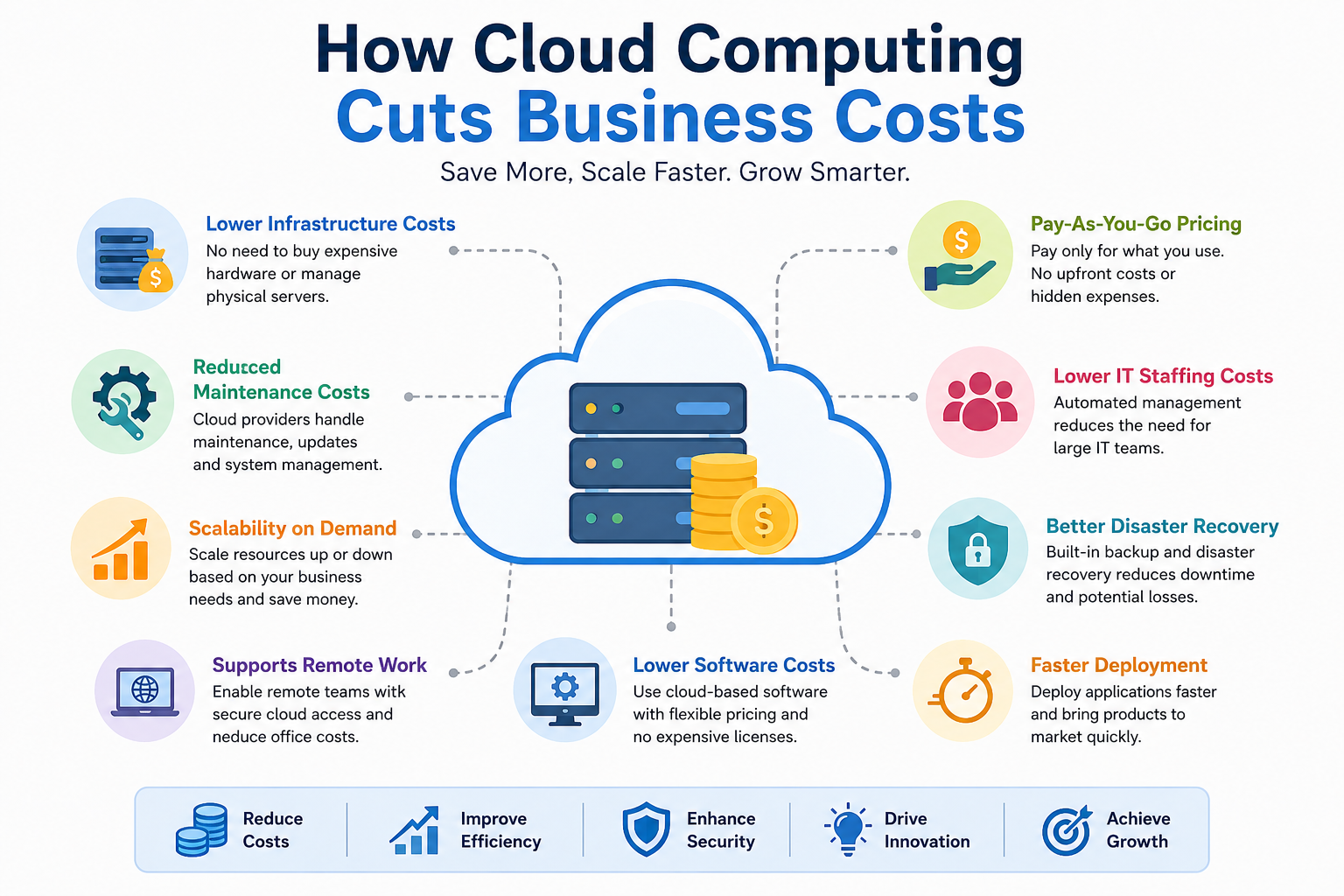
How Cloud Computing Cuts Business Costs: Your Go-To Guide for 2026
🔥 Fresh Cloud Computing Insights – June–July 2026
🚨 AI-Driven Cloud Services Are Helping Businesses Save More Than Ever
During June and July 2026, leading cloud providers including Amazon Web Services (AWS), Microsoft Azure, Google Cloud Platform (GCP) and Oracle Cloud introduced powerful AI-powered cloud services, enhanced serverless computing, and automated cloud optimization tools. These innovations help businesses lower infrastructure costs, improve performance, automate resource management, and optimize cloud spending.
Cloud providers are also expanding Artificial Intelligence (AI), Machine Learning (ML), multi-cloud management, advanced cloud security, real-time cost optimization dashboards, and intelligent infrastructure monitoring. Businesses now have greater visibility into cloud expenses while improving operational efficiency and business scalability.
As organizations increasingly adopt Cloud Computing, AI Automation, Machine Learning, and Data Analytics, cloud technology has become one of the most cost-effective investments for modern businesses.
Introduction
Technology continues transforming the way businesses operate, and one of the biggest drivers behind this transformation is Cloud Computing. Organizations no longer need to invest heavily in expensive servers, physical data centers, networking hardware, or complex IT infrastructure to operate their applications.
Instead, businesses can access computing resources over the internet and pay only for what they actually use. This flexible pricing model reduces capital expenditure, simplifies IT management, improves scalability, and enables organizations to expand quickly without massive upfront investments.
From startups and small businesses to multinational enterprises, Cloud Computing helps organizations lower operational costs, improve collaboration, strengthen cybersecurity, accelerate digital transformation, and enhance business continuity.
In 2026, Cloud Computing is no longer just an IT solution. It has become a strategic business investment that enables companies to innovate faster, improve productivity, adopt Artificial Intelligence, and remain competitive in today's digital economy.
This guide explains how cloud computing helps businesses reduce costs, improve efficiency, and build a stronger foundation for long-term growth.
What Is Cloud Computing?
Cloud Computing is the delivery of computing services over the internet instead of relying on expensive on-premise infrastructure. Organizations can access computing resources whenever they need them without purchasing physical hardware.
Cloud Computing services include:
- Servers
- Cloud Storage
- Databases
- Networking
- Software Applications
- Artificial Intelligence
- Machine Learning
- Data Analytics
- Cybersecurity Services
- Backup & Disaster Recovery
Instead of purchasing expensive infrastructure, businesses simply rent cloud resources from providers and pay only for the services they consume.
Some of the world's leading cloud platforms include:
- Amazon Web Services (AWS)
- Microsoft Azure
- Google Cloud Platform (GCP)
- Oracle Cloud Infrastructure (OCI)
- IBM Cloud
These providers offer scalable cloud infrastructure suitable for startups, SMEs, and large enterprises across every industry.
Why Cloud Computing Matters in 2026
Modern businesses need flexibility, scalability, security, and rapid deployment to remain competitive in today's digital economy. Traditional IT infrastructure often requires significant upfront investments, continuous maintenance, software upgrades, and dedicated IT teams.
Cloud Computing removes these challenges by providing on-demand computing resources that grow alongside business needs. Organizations can quickly launch applications, store large amounts of data, support remote employees, and integrate Artificial Intelligence without investing in expensive physical infrastructure.
Today, businesses use cloud services for:
- Website Hosting
- Business Applications
- Cloud Storage
- Software Development
- Artificial Intelligence (AI)
- Machine Learning (ML)
- Customer Relationship Management (CRM)
- Enterprise Resource Planning (ERP)
- Cybersecurity
- Remote Work Solutions
- Business Analytics
- Data Backup & Disaster Recovery
As businesses continue adopting AI, Automation, and Digital Transformation strategies, cloud computing has become the backbone of modern business operations.
How Cloud Computing Reduces Business Costs
1. Eliminates Expensive Hardware Investments
Traditional IT infrastructure requires businesses to purchase costly hardware such as physical servers, storage devices, networking equipment, backup systems, cooling solutions, and dedicated data center space. These investments often cost thousands—or even millions—of dollars depending on business size.
With Cloud Computing, businesses no longer need to buy and maintain expensive hardware. Cloud providers own, manage, and upgrade the infrastructure while customers simply rent the computing resources they require.
- Lower Capital Expenditure (CapEx)
- No Server Purchases
- No Data Center Costs
- Reduced Hardware Maintenance
- Pay Only for Actual Usage
2. Pay-As-You-Go Pricing
One of the biggest advantages of cloud computing is its flexible Pay-As-You-Go Pricing Model. Instead of purchasing infrastructure that may sit unused, businesses only pay for the resources they actually consume.
Organizations pay based on:
- Storage Usage
- CPU Resources
- Memory Consumption
- Database Usage
- Network Traffic
- Cloud Applications
- AI Services
This pricing model allows companies to optimize IT budgets while avoiding unnecessary investments.
3. Lower Maintenance Costs
Maintaining on-premise infrastructure requires constant attention. Businesses must regularly perform:
- Hardware Upgrades
- Software Updates
- Security Patch Management
- System Monitoring
- Backup Administration
- Network Maintenance
Cloud providers automatically manage these responsibilities, significantly reducing operational costs while allowing internal IT teams to focus on innovation instead of maintenance.
4. Reduced IT Staffing Costs
Operating traditional infrastructure often requires a large IT department responsible for servers, storage, security, backups, and networking.
Cloud Computing automates much of this infrastructure management. Businesses can operate with leaner IT teams while still maintaining enterprise-grade infrastructure.
Benefits include:
- Lower Recruitment Costs
- Reduced Training Expenses
- Smaller Infrastructure Teams
- Higher Employee Productivity
- Lower Operational Costs
5. Improved Business Scalability
Business demand constantly changes. Traditional infrastructure often forces organizations to purchase extra servers "just in case" demand increases.
Cloud platforms provide instant scalability. Organizations can increase or decrease computing resources whenever needed.
Common scenarios include:
- Holiday Sales
- Marketing Campaigns
- Product Launches
- Business Expansion
- Unexpected Traffic Growth
This flexibility prevents businesses from overspending on unused infrastructure.
6. Better Disaster Recovery
Unexpected system failures, cyberattacks, or natural disasters can cause significant financial losses. Cloud Computing offers built-in disaster recovery capabilities that improve business continuity.
Cloud providers typically include:
- Automatic Backups
- Disaster Recovery
- Data Replication
- Business Continuity Solutions
- High Availability Infrastructure
These features minimize downtime while protecting valuable business data.
7. Lower Software Licensing Costs
Many cloud applications now use subscription-based pricing instead of expensive one-time software licenses. Businesses pay monthly or annually according to actual usage.
Popular cloud software includes:
- Microsoft 365
- Google Workspace
- Salesforce CRM
- Adobe Creative Cloud
- Zoom
- Slack
This reduces upfront software investments while ensuring businesses always use the latest software versions.
8. Supports Remote Work
Cloud Computing enables employees to work securely from anywhere using internet-connected devices. Teams can access business applications, cloud storage, files, and collaboration platforms without depending on office infrastructure.
- Cloud File Sharing
- Video Meetings
- Team Collaboration
- Remote Application Access
- Secure Cloud Storage
Remote work reduces office expenses while increasing employee productivity and flexibility.
9. Faster Software Deployment
Cloud infrastructure allows developers to launch applications much faster than traditional environments. Development teams can create servers, deploy software, test applications, and scale infrastructure within minutes.
- Rapid Development
- Faster Testing
- Quick Deployment
- Continuous Integration
- Continuous Delivery (CI/CD)
Faster deployments reduce development costs and help businesses respond more quickly to changing market demands.
10. AI and Automation Reduce Operational Costs
Modern cloud platforms integrate powerful technologies such as:
- Artificial Intelligence (AI)
- Machine Learning (ML)
- Predictive Analytics
- Cloud Automation
- AI Chatbots
- Business Intelligence
- Data Analytics
These technologies automate repetitive tasks, improve decision-making, reduce manual workloads, optimize cloud resources, and increase overall business efficiency. Organizations can serve more customers while spending less on routine operations.
Types of Cloud Computing
Businesses can choose different Cloud Computing deployment models based on their security requirements, budget, scalability needs, and business objectives. Each model offers unique advantages depending on the organization's workload and infrastructure requirements.
1. Public Cloud
A Public Cloud is owned and managed by third-party cloud providers such as AWS, Microsoft Azure, and Google Cloud Platform. Businesses share computing infrastructure while paying only for the resources they consume.
Public Cloud is ideal for:
- Startups
- Small Businesses
- Web Applications
- Development & Testing
- Growing Companies
2. Private Cloud
A Private Cloud provides dedicated cloud infrastructure exclusively for one organization. It offers higher security, greater customization, and complete control over data and applications.
Private Cloud is commonly used by:
- Banks
- Healthcare Organizations
- Government Agencies
- Large Enterprises
- Financial Institutions
3. Hybrid Cloud
Hybrid Cloud combines both Public Cloud and Private Cloud environments. Businesses can keep sensitive data in a private cloud while using public cloud services for scalable workloads.
Benefits include:
- Greater Flexibility
- Improved Security
- Better Cost Management
- Business Continuity
- Scalable Infrastructure
4. Multi-Cloud
A Multi-Cloud Strategy involves using services from multiple cloud providers instead of relying on a single vendor.
Businesses choose Multi-Cloud to:
- Avoid Vendor Lock-in
- Improve Reliability
- Increase Availability
- Optimize Costs
- Choose Best Services from Different Providers
Industries Using Cloud Computing
Today, Cloud Computing powers businesses across almost every industry. Organizations rely on cloud technology to improve productivity, reduce operational costs, increase security, and accelerate digital transformation.
- Healthcare
- Banking & Financial Services
- Education
- Retail
- E-commerce
- Manufacturing
- Government
- Telecommunications
- IT Services
- Travel & Hospitality
- Real Estate
- Logistics & Supply Chain
- Insurance
- Media & Entertainment
- Digital Marketing Agencies
Whether it's storing customer information, hosting websites, running enterprise applications, or deploying AI solutions, cloud computing has become the foundation of modern business operations.
Cloud Computing and Artificial Intelligence (AI)
The rapid advancement of Artificial Intelligence (AI) has made Cloud Computing even more valuable for businesses. Cloud platforms provide the computing power, storage, and scalability required to build, train, and deploy AI applications efficiently.
Businesses now use AI-powered cloud services for:
- Predictive Analytics
- AI Chatbots
- Customer Support Automation
- Fraud Detection
- Image Recognition
- Natural Language Processing (NLP)
- Business Intelligence
- Marketing Automation
- Recommendation Systems
- Machine Learning Model Training
Cloud providers continue investing heavily in AI infrastructure, making advanced technologies more accessible and affordable for businesses of every size.
Best Practices for Cloud Cost Optimization
Simply migrating to the cloud does not automatically reduce costs. Businesses should continuously monitor and optimize their cloud environments to maximize Return on Investment (ROI).
Recommended best practices include:
- Monitor cloud spending regularly.
- Delete unused virtual machines.
- Optimize storage utilization.
- Enable Auto Scaling.
- Select the most suitable pricing model.
- Use Serverless Computing where appropriate.
- Implement automated backups.
- Secure cloud infrastructure.
- Review cloud performance reports.
- Conduct regular cloud cost audits.
Following these practices helps organizations control cloud expenses while improving overall efficiency.
Common Mistakes Businesses Should Avoid
Many organizations fail to fully optimize their cloud environments, resulting in unnecessary spending. Some of the most common mistakes include:
- Leaving unused virtual machines running.
- Overprovisioning cloud resources.
- Ignoring cloud monitoring tools.
- Storing unnecessary data.
- Poor security configurations.
- Skipping disaster recovery planning.
- Not optimizing workloads.
- Failing to monitor cloud billing.
- Using outdated cloud architectures.
- Ignoring regular cloud audits.
Avoiding these mistakes helps businesses maximize performance, improve security, and significantly reduce cloud operating costs.
Future of Cloud Computing
The future of Cloud Computing is brighter than ever. As businesses continue embracing Artificial Intelligence (AI), automation, big data, and digital transformation, cloud technology will become even more intelligent, secure, and cost-efficient.
Industry experts predict that organizations will increasingly adopt cloud-native applications, AI-powered infrastructure, serverless computing, and multi-cloud environments to improve flexibility and reduce operational costs. Cloud providers are also investing heavily in sustainability initiatives, making cloud infrastructure more energy-efficient while supporting global environmental goals.
Key trends expected to shape the future of cloud computing include:
- AI-Powered Cloud Infrastructure
- Serverless Computing
- Edge Computing
- Green Cloud Computing
- Cloud Security Automation
- Quantum Cloud Computing
- Hybrid Cloud Solutions
- Multi-Cloud Strategies
- Cloud-Based AI Development
- Intelligent Cloud Analytics
Businesses that invest in cloud technologies today will be better prepared for tomorrow's digital economy and future technological innovations.
Frequently Asked Questions (FAQs)
1. What is Cloud Computing?
Cloud Computing is the delivery of computing services such as servers, storage, databases, networking, software, and AI over the internet, allowing businesses to access resources without owning physical infrastructure.
2. How does Cloud Computing reduce business costs?
Cloud Computing reduces costs by eliminating expensive hardware purchases, lowering maintenance expenses, enabling pay-as-you-go pricing, improving scalability, supporting remote work, and reducing IT staffing requirements.
3. Is Cloud Computing secure?
Yes. Leading cloud providers such as AWS, Microsoft Azure, and Google Cloud invest billions of dollars in cybersecurity, encryption, compliance, and continuous monitoring to protect customer data.
4. Which industries benefit from Cloud Computing?
Almost every industry benefits from Cloud Computing, including Healthcare, Banking, Education, Manufacturing, Retail, Government, Logistics, IT Services, Real Estate, and E-commerce.
5. Which are the leading Cloud Computing platforms?
Some of the world's leading cloud providers include Amazon Web Services (AWS), Microsoft Azure, Google Cloud Platform (GCP), Oracle Cloud Infrastructure (OCI), and IBM Cloud.
Conclusion
In 2026, Cloud Computing has become one of the most valuable technologies for businesses looking to reduce operational costs while improving efficiency, scalability, and innovation. Instead of investing heavily in physical infrastructure, organizations can leverage cloud platforms to access enterprise-grade computing resources whenever needed.
Modern cloud solutions help businesses reduce hardware expenses, simplify IT management, support remote work, strengthen cybersecurity, accelerate software deployment, and integrate powerful technologies such as Artificial Intelligence (AI), Machine Learning (ML), and Business Automation.
As cloud providers continue introducing AI-powered services, serverless technologies, intelligent cost optimization tools, and advanced security features, businesses adopting cloud computing will gain a significant competitive advantage in the rapidly evolving digital landscape.
Whether you're a startup, a growing company, or a large enterprise, investing in Cloud Computing is no longer just an IT decision—it's a strategic business investment that supports long-term growth, operational efficiency, and digital transformation.
Related Articles (Internal Links)
- Technical SEO Updates Every Website Owner Should Know
- AI Agents vs Chatbots: What's the Difference?
- WhatsApp Automation: The Complete Guide for Businesses
- How AI Is Revolutionizing Social Media Marketing
- Top SEO Trends Businesses Must Follow in 2026
- Customer Journey Mapping Explained
- Why TypeScript Is Becoming the Standard for Modern Development
Helpful External Resources
- Amazon Web Services (AWS)
- Microsoft Azure
- Google Cloud Platform
- Oracle Cloud
- IBM Cloud
- Google Cloud Learning
- Microsoft Learn - Azure
High-Volume SEO Keywords
Cloud Computing, Cloud Services, AWS, Microsoft Azure, Google Cloud Platform, Cloud Infrastructure, Cloud Migration, Serverless Computing, Cloud Security, Cloud Cost Optimization, Artificial Intelligence, Machine Learning, Hybrid Cloud, Multi-Cloud, Business Automation, Digital Transformation, Cloud Storage, Edge Computing, Cloud Analytics, Enterprise Cloud Solutions
About Jisnu Digital
Jisnu Digital provides expert insights on Cloud Computing, Artificial Intelligence, SEO, Digital Marketing, Software Development, Business Automation, and emerging technologies to help businesses grow in today's competitive digital landscape.