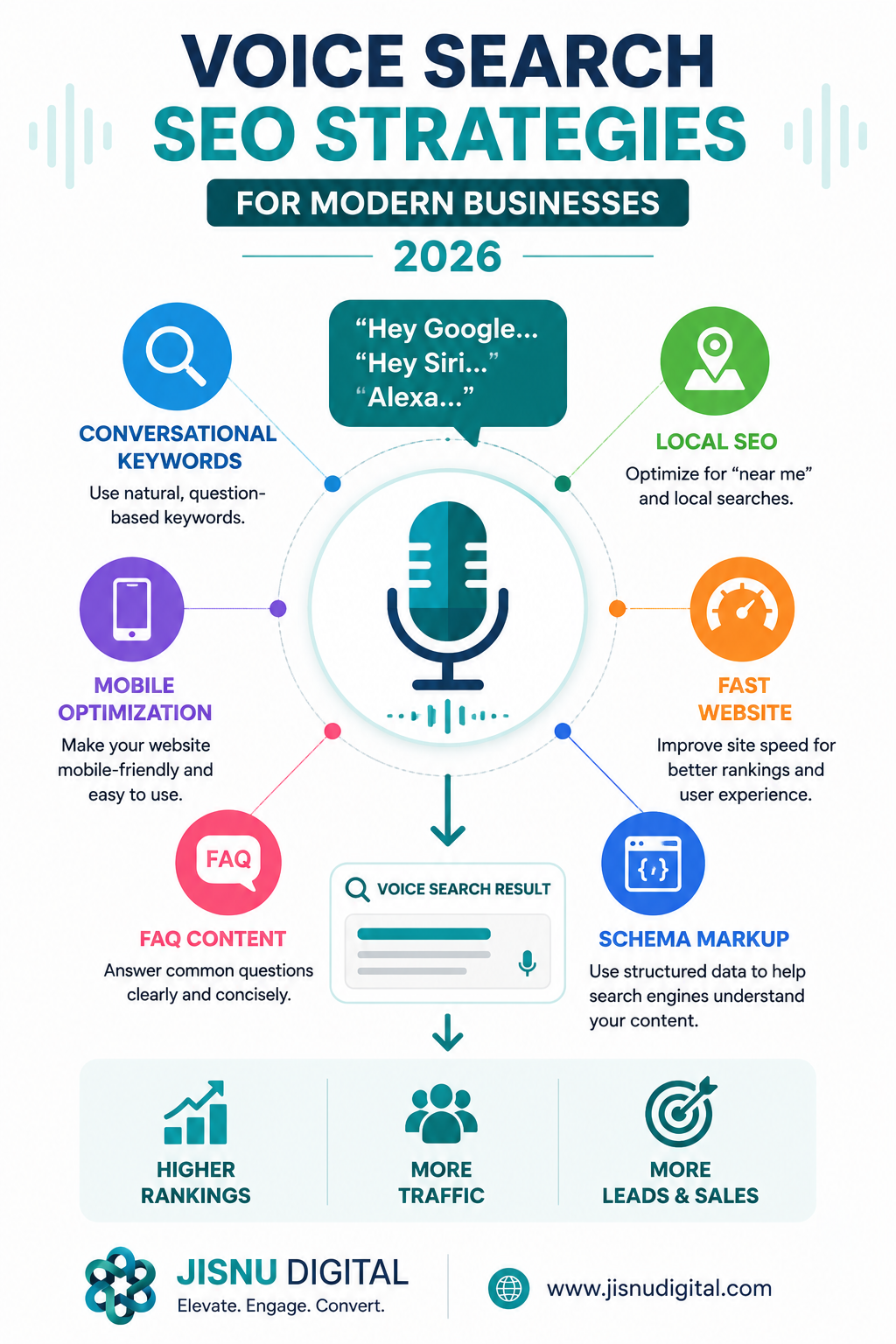
Voice Search SEO Strategies for Modern Businesses: The Complete Guide for 2026
Introduction
The way we search online is evolving at lightning speed. Instead of just typing in a few keywords, more and more people are using voice commands to find information, products, services, and local businesses. With the rise of smartphones, smart speakers, virtual assistants, and AI-driven search tools, Voice Search has firmly established itself as a key player in today’s digital marketing landscape.
Voice Search SEO is the process of optimizing websites and content so they appear in voice search results. Unlike traditional SEO, which mainly focuses on typed queries, Voice Search SEO is tailored to respond to conversational and natural-language questions asked through devices such as Google Assistant, Siri, Alexa, and Samsung Bixby.
To understand the fundamentals of search optimization, explore our Search Engine Optimization (SEO) guide.
As technology keeps advancing, businesses that embrace voice search optimization can gain a competitive edge, enhance their visibility, and connect with customers precisely when they are seeking information.
What Is Voice Search SEO?
Voice Search SEO is all about fine-tuning digital content to boost visibility in voice search results. When someone poses a question to a voice-enabled device, search engines strive to deliver the most accurate and relevant answer.
Unlike traditional searches that often consist of short phrases like "best digital marketing agency Pune," voice searches tend to be longer and more conversational.
Examples include:
- "Which is the best digital marketing agency in Pune?"
- "How can I improve my website's SEO ranking?"
- "What are the benefits of social media marketing for small businesses?"
Since voice searches reflect natural human conversation, businesses need to adapt their SEO strategies accordingly.
The Rise of Voice Search in 2026
Voice search adoption has grown significantly due to advancements in Artificial Intelligence (AI) and Natural Language Processing (NLP).
Today, people use voice search for:
- Finding local businesses
- Researching products
- Getting service recommendations
- Navigating directions
- Customer support inquiries
- Online shopping
- Educational research
Modern voice assistants can understand context, intent, location, and user behavior, making voice search more accurate than ever.
Why Voice Search Matters for Businesses
Voice search is reshaping how users engage with search engines. Businesses that fail to adapt risk losing valuable visibility and traffic.
One of the biggest advantages of voice search is its ability to capture high-intent users. People using voice search are often looking for immediate answers or solutions.
For example, someone typing "restaurant near me" may simply be researching options. However, a user asking "What’s the best restaurant near me that’s open right now?" typically has stronger purchase intent.
Voice Search SEO also improves:
- Website visibility
- Organic traffic
- Local SEO performance
- User experience
- Mobile search rankings
- Conversion opportunities
Key Voice Search SEO Strategies
Focus on Conversational Keywords
Traditional SEO often focuses on short keywords, while voice searches tend to be longer and more conversational.
Instead of targeting:
"SEO Services"
Businesses should optimize for:
- "What are the best SEO services for small businesses?"
- "How much do SEO services cost?"
- "Which SEO agency can help improve website rankings?"
Using long-tail conversational keywords allows search engines to better understand user intent.
Optimize for Question-Based Searches
Most voice searches are framed as questions.
Common formats include:
- Who
- What
- When
- Where
- Why
- How
Businesses should create content that directly answers these questions. FAQ sections can significantly improve visibility in voice search results.
Enhance Local SEO
A significant portion of voice searches are local in nature.
Examples include:
- "Best coffee shop near me"
- "Digital marketing agency in Pune"
- "Nearest hospital open now"
To optimize for local voice searches:
- Claim and optimize Google Business Profile
- Use location-specific keywords
- Maintain accurate business information
- Encourage customer reviews
- Create local content
Learn more about local search strategies through Google Search Documentation.
Create Featured Snippet-Friendly Content
Voice assistants frequently pull answers directly from Google's Featured Snippets.
Businesses should structure content with:
- Clear headings
- Short answers
- Bullet points
- FAQ sections
- Well-organized information
Optimize for Mobile Devices
Most voice searches occur on mobile devices. Having a mobile-friendly website is essential for voice search success.
- Responsive design
- Fast loading speed
- Easy navigation
- Mobile usability
- Core Web Vitals optimization
Boost Website Speed
Voice search users expect immediate answers. Slow websites can negatively impact rankings and user experience.
- Image compression
- Browser caching
- Code optimization
- Content Delivery Networks (CDNs)
- Efficient hosting solutions
Utilize Structured Data and Schema Markup
Schema markup helps search engines better understand website content and improves the chances of appearing in rich search results.
Learn more about Schema Markup from Schema.org.
The Role of AI in Voice Search SEO
Artificial Intelligence is at the heart of today’s voice search technology.
AI helps search engines:
- Understand user intent
- Process natural language
- Interpret context
- Provide personalized results
- Improve answer accuracy
As AI-driven assistants continue evolving, businesses need to focus on creating content that genuinely helps users rather than simply targeting keywords.
For more insights, read our guide on Digital Marketing Trends & AI Marketing.
Common Mistakes Businesses Should Avoid
- Ignoring conversational keywords
- Neglecting local SEO
- Poor mobile optimization
- Slow website performance
- Lack of FAQ content
- Missing schema markup
- Writing content only for search engines instead of users
Avoiding these mistakes can significantly improve visibility in voice search results.
Future of Voice Search SEO
The future of search is becoming increasingly conversational.
Technologies such as ChatGPT Voice, Google Gemini, Alexa AI, and Siri Intelligence are making voice interactions a natural part of everyday life.
Businesses that invest in Voice Search SEO today will be better positioned to capture future search traffic, improve user engagement, and strengthen their digital presence.
Conclusion
Voice Search SEO is transforming how businesses connect with online audiences. As more consumers rely on voice-enabled devices and AI assistants, optimizing for conversational searches has become essential.
Modern businesses should focus on conversational keywords, question-based content, local SEO, mobile optimization, website speed, structured data, and high-quality user-focused content.
Those who embrace Voice Search SEO early will gain a significant competitive advantage, improve search visibility, and position themselves for long-term success in the evolving digital landscape.
```